
A Practicle Guide for Property Owners, Facilities Managers and Operations Teams across Australia
What is Preventative and Reactive Maintenance
In commercial building management, your maintenance strategy is one of the most consequential financial decisions you make, yet it rarely gets the boardroom attention it deserves.
Preventative maintenance is scheduled servicing carried out before equipment fails. Reactive maintenance is work performed only after a breakdown has occurred.
On paper, reactive maintenance looks cheaper. No service contract, no regular invoices, no planned visits during quieter periods. That perception is exactly why many organisations default to it, and why they end up paying significantly more over time.
The real cost of running a commercial building is not measured by the volume of invoices you receive. It is measured by the total cost of keeping the building operational, compliant, and productive. Those are very different numbers.
| Industry data indicates that facilities running reactive maintenance programs spend an average of 4.8 times more per repair event than those executing the same work under a planned maintenance schedule. (OxMaint Building Maintenance Management Report, 2026) |
Why the Cost Difference Is Bigger Than It Looks
When a system fails unexpectedly, the cost you pay is never limited to the repair itself. A single failure creates a chain reaction that touches multiple cost centres simultaneously:
- Emergency contractor sourcing — often at short notice with limited supplier choice
- After-hours and weekend labour at premium rates, typically 1.5–2× standard charge-out
- Urgent parts procurement, which may carry freight premiums or require temporary equipment hire
- Collateral damage to adjacent systems exposed to the failure
- Regulatory exposure if safety-critical systems are non-functional
- Reputational impact with tenants, clients, or stakeholders
Preventative maintenance reduces the probability of that chain ever beginning. The distinction is not simply maintenance versus repair. It is planned cost versus uncontrolled risk.
The Real Cost Equation
Total building maintenance cost is best understood this way:
|
Total Cost = Repair Cost + Operational Disruption + Downtime Loss + Accelerated Capital Replacement |
Reactive maintenance increases every component of that equation simultaneously. The most common budgeting mistake facility managers make is counting only contractor invoices while ignoring what sits behind them.
Consider what “operational disruption” actually means in dollar terms. For a commercial office building, a failed HVAC system during a Sydney summer does not just create a service call. It affects staff comfort, productivity and retention. It may trigger lease obligations around habitability. It generates tenant complaints that consume management time and, in some cases, result in rent abatements or early termination clauses being exercised.
None of that appears on a maintenance invoice. All of it is a direct cost of reactive management.
A Practical Example: HVAC Failure in a Commercial Building
Consider a mid-sized commercial office building. The air-conditioning system services three floors and was installed eight years ago. Under a reactive strategy, servicing occurs only when something breaks.
During a February heatwave, the compressor fails. A technician needs to be sourced urgently. Emergency call-out fees apply. The parts required are not in stock locally. The system is down for four days. Internal temperatures rise. Staff work from home or leave early. Tenants escalate formally. A temporary cooling hire unit is brought in at daily cost.
Now consider the same building under a preventative schedule. A quarterly service three months earlier identified early-stage compressor wear and flagged the refrigerant level as marginal. A minor repair and refrigerant top-up was completed at a scheduled rate. The compressor runs through summer without incident.
The difference is not theoretical. It is the difference between a planned $600 service visit and an unplanned event costing many thousands of dollars in repairs, downtime, and tenant management.
Industry benchmarks for commercial HVAC specifically tell a clear story:
- HVAC systems represent approximately 39% of total commercial building energy consumption
- Reactive emergency HVAC repair costs run 3–5 times higher than the equivalent scheduled maintenance visit
- Structured preventative maintenance programs reduce unplanned HVAC downtime by up to 73%
- Well-maintained HVAC systems can achieve energy savings of up to 40% compared to neglected equipment
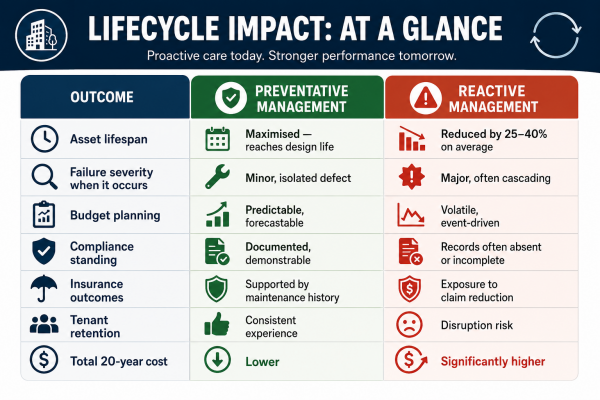
Side-by-Side Comparison
Factor |
Preventative Maintenance |
Reactive Maintenance |
|
Labour ratesLabour |
Scheduled, standard rates |
Emergency premium rates (1.5–2×) |
|
Parts procurement |
Planned, supplier-priced |
Urgent, premium-priced |
|
Building downtime |
Minimal |
Often significant |
|
Tenant experience |
Consistent service delivery |
Disruption and complaints |
|
Equipment lifespan |
Full design life |
Shortened by 5–8 years |
|
Budget predictability |
Stable, forecastable |
Volatile, reactive |
|
Compliance exposure |
Low — records maintained |
Elevated — records often absent |
|
Insurance claims impact |
Supported by service records |
Frequently contested or reduced |
How Reactive Maintenance Shortens Asset Life
Mechanical systems do not fail suddenly. They deteriorate gradually through a predictable sequence:
Minor wear → Increased friction / heat → Component fatigue → System failure
Without regular servicing, minor wear in one component spreads through the system. What could have been a $150 bearing replacement becomes a $4,000 motor replacement. What could have been a filter clean becomes a coil replacement. What could have been a belt swap becomes a compressor failure.
A system with a designed lifespan of 20 years, managed reactively, commonly fails 5–8 years early. At that point, you are no longer looking at a maintenance cost problem. You are looking at a capital expenditure problem, one that was not in your long-term plan and not funded in your asset replacement budget.
The third financial mechanism of preventative maintenance, delayed capital replacement, is consistently the largest source of savings over a full asset lifecycle. Extending equipment life by even three to five years changes the shape of a long-term property budget significantly.
Australian Maintenance Standards and Intervals
A compliant preventative maintenance program in Australia is not simply best practice, for certain building systems, it is a legal requirement. The following intervals reflect both common industry practice and relevant Australian Standards:
Building Systems |
Typical Maintenance Interval/ Standard |
| HVAC systems | Monthly, quarterly & annual servicing: AS3666 and DA19 |
| Fire protection systems | Monthly / quarterly inspections under AS 1851 (fire sprinkler systems) |
| Emergency lighting | 6-monthly functional testing under AS/NZS 2293.2 |
| Passenger lifts | Monthly statutory inspection requirements (state-regulated) |
| Electrical switchboards | Annual thermal imaging inspection; IEC 60364 compliance |
| Building management systems | Quarterly calibration; annual full review |
| Hydraulic systems (plumbing) | Annual inspection; backflow prevention testing |
| Roof and drainage | Bi-annual inspection; post-storm inspection recommended |
It is worth noting that AS 1851 (maintenance of fire protection systems) and AS/NZS 2293 (emergency lighting) are referenced in the National Construction Code and carry legal enforceability in most Australian jurisdictions. These are not discretionary.
Maintenance Budget Planning for the Long Term
The financial benefits of preventative maintenance compound over time. A practical long-term planning approach looks like this:
- Conduct a full asset register audit to understand what you have, its age, and its condition
- Assign expected remaining lifespan to each asset category
- Apply the appropriate maintenance schedule and forecast annual servicing costs
- Identify the projected replacement year for each major asset
- Spread replacement cost across the years remaining in the asset’s life (annual sinking fund contribution)
- Review and update annually as condition data accumulates
This approach transforms maintenance from a reactive cost centre into a planned financial strategy. It gives boards, owners, and CFOs visibility over long-term capital requirements years in advance, which is particularly valuable in the current environment of elevated construction and equipment costs.
Frequently Asked Questions
Across a full asset lifecycle, yes, and the margin is substantial. The U.S. Department of Energy, corroborated by multiple facility management studies, consistently shows a $5 saving for every $1 invested in preventative maintenance. For Australian commercial buildings specifically, structured programs have been documented to reduce total maintenance costs by around 30% compared to reactive operations. There are narrow situations, very low-use assets near end of life, or assets with extremely low failure consequences, where a run-to-failure strategy makes economic sense. But for the critical systems in a commercial building (HVAC, fire, electrical, lifts), preventative maintenance is consistently the lower-cost strategy when total ownership cost is accounted for correctly.
Short-term budget pressure is the primary driver. Preventative maintenance requires upfront spend on servicing and planning; reactive maintenance defers cost until something breaks. For organisations measured on annual budget performance rather than long-term asset health, the reactive approach can appear favourable in any given year. The second factor is asset visibility, many facilities managers simply do not have a complete picture of what equipment they have, its age, or its service history. Without that foundation, structured planning is difficult. A simple asset register audit is usually the most impactful first step.
Premature capital replacement. When equipment fails years ahead of its designed lifespan because it has not been maintained, the replacement cost lands unexpectedly and is rarely funded in advance. A commercial HVAC system that should last 20 years failing at 12–14 years is not unusual under purely reactive management. At current equipment and installation costs in Australia, that represents a significant unplanned capital event that affects balance sheets, borrowing capacity, and long-term property value.
Insurers assess claims in the context of whether the claimant exercised reasonable duty of care. In commercial building insurance, that increasingly means demonstrating a documented maintenance program. A lack of service records, or a pattern of reactive-only interventions, can result in claims being reduced, contested, or in some cases denied on the basis of inadequate maintenance. At renewal, poor maintenance history can also attract higher premiums or reduced coverage. Maintenance records are, in practical terms, a financial asset, they protect the value of your insurance policy.
Yes, directly. The Work Health and Safety Act 2011 requires PCBUs (persons conducting a business or undertaking) to maintain safe plant and structures. That is an ongoing, proactive obligation, not a reactive one. Operating purely reactively does not satisfy this duty, and in the event of a safety incident or regulatory investigation, the absence of maintenance records is a significant liability. Category 1 WHS offences now carry corporate penalties of up to $17 million, indexed annually. Beyond WHS, the National Construction Code, fire safety orders, and building certification requirements all interact with ongoing maintenance obligations.
Significantly. HVAC systems running with dirty coils, degraded refrigerant charge, or worn components consume substantially more energy than well-maintained equivalents. Industry data shows energy consumption differences of up to 40% between maintained and unmaintained HVAC equipment of the same age. In the context of rising electricity costs in Australia, this is not a marginal benefit. For buildings with substantial HVAC loads, which is most commercial office, retail, and healthcare facilities, maintenance schedule compliance directly translates to energy cost reduction.
The Bottom Line
The choice between preventative and reactive maintenance is not a maintenance philosophy debate. It is a financial decision with quantifiable, well-documented outcomes.
Reactive maintenance appears cheaper at the invoice level. Over the lifecycle of a commercial building, it consistently costs more, in repair expenditure, operational disruption, shortened asset life, compliance risk, insurance exposure, and unplanned capital events.
Preventative maintenance requires planning, discipline, and upfront investment. It delivers predictable costs, longer asset life, lower total expenditure, stronger compliance standing, and better outcomes for the people who occupy and operate the building.
For any commercial property owner, facilities manager, or operations team serious about long-term asset value, a structured preventative maintenance program is not a cost, it is a strategy.
CBC Group delivers Asset Management, Facilities Management, and Construction Services to clients across Australia. Our approach to facilities maintenance is built around structured preventative programs, documented service delivery and long-term asset lifecycle planning, not reactive firefighting.